This past March, when Steve Wozniak, the cofounder of Apple, was interviewed about the company’s 50th anniversary, one of the first things he said was that Apple was “the best, the most humanist of the big tech companies.”
The most humanist?
As of this writing, Apple is worth an eye-watering four and a half trillion dollars. Last year, it raked in about $416 billion in revenue. There are roughly 540 Apple Stores operating in 27 countries around the world. Apple dominates the tablet market. About one in five people has an iPhone.
And yet, with all these impressive achievements and sales figures easily within reach, the cofounder chose to praise the company for being “the most humanist.”
To some, this might be a surprising superlative to trumpet—that is until they understand that Apple’s vision is largely indistinguishable from Steve Jobs’s. And Steve Jobs always had a passion for the humanities. In fact, one of the things that made Jobs unique among executives—and there were many—was that he knew how to use the humanities. He understood that when the humanities and technology were successfully combined, a remarkable synergy resulted.
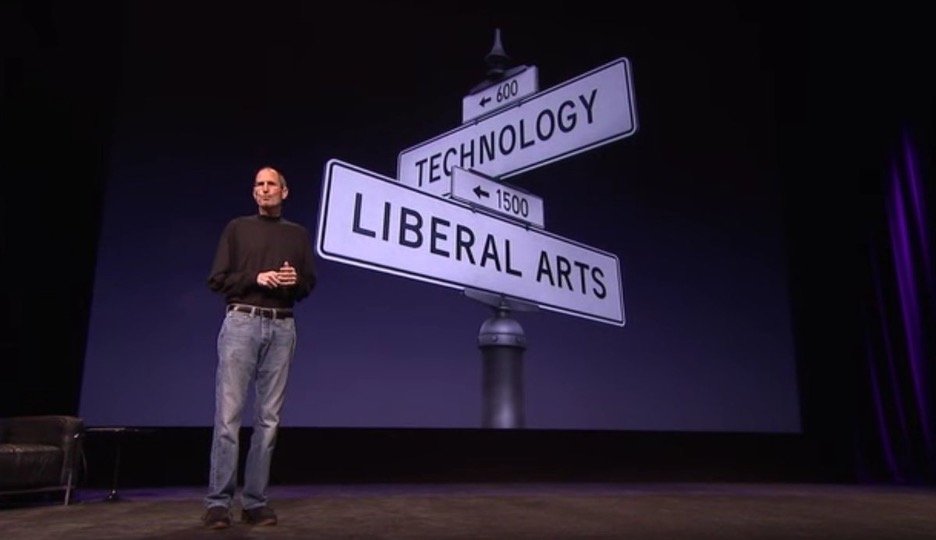
Although the Goodbar Principle had not yet been fully articulated, Jobs, at the launch for the iPad 2 in 2011, seemed eerily aware of its central thesis. He said, “It’s in Apple’s DNA that technology alone is not enough. We believe that it’s technology married with the humanities that yields us the results that make our heart sing.”
So how did Jobs marry technology with the humanities? There are the obvious examples, of course. One can look at how Apple revolutionized the music and publishing industries, ushering in an era of digital music and digital books. One can look at the iPod or iTunes or the fact that Apple devices feature applications like iMovie and GarageBand, which enable users to create their own art. And then there’s Pixar, which Jobs bought from a divorce-ridden George Lucas in 1986. At Pixar, Jobs nurtured a film studio that combined cutting-edge 3D computer graphics with consummate storytelling. The results speak for themselves—Toy Story; Monsters, Inc.; Finding Nemo; Ratatouille. As Walter Isaacson writes in his Jobs biography, Jobs’s instinct for “combining great art and digital technology would transform animated films more than anything had since 1937, when Walt Disney had given life to Snow White.”
Again, these are some of the more obvious examples of how Jobs tapped the humanities. But I want to dig a little deeper. I want to probe a bit further. I want to see how exactly the arts informed Jobs’s approach to technology and business. And while it’s fair to say that many of the arts influenced him, there was one that, above all else, inspired and guided him—music. Without music, there’s a possibility that there would be no Apple.
Jobs and Wozniak first bonded over their shared love of Bob Dylan. That bond deepened as they parsed his lyrics together and drove up and down the state of California in search of bootlegged Dylan concerts. Throughout Jobs’s life, music would be central to his identity, and he would constantly borrow ideas from it and use it as an inexhaustible source of analogies. It seems that it was with musicians, more than with any other kind of artist, that he most identified.
Aside from Dylan, the music that made the biggest impact on Jobs was that of the Beatles. And in Isaacson’s book, there’s a passage that suggests that from listening to a bootleg CD that featured taped sessions of the Beatles perfecting “Strawberry Fields Forever,” Jobs developed his design philosophy, which was centered around iterating and iterating on a product, experimenting with countless little tweaks and variations until the final, perfect form was found.
Jobs played the bootleg for Isaacson and then explained what it had taught him:
It’s a complex song, and it’s fascinating to watch the creative process as they went back and forth and finally created it over a few months…. [He laughs as Lennon stops during the first take and makes the band go back and revise a chord.] Did you hear that detour they took? It didn’t work, so they went back and started from where they were. It’s so raw in this version…. They just didn’t stop. They were such perfectionists they kept it going and going. This made a big impression on me when I was in my thirties. You could just tell how much they worked at this.
They did a bundle of work between each of these recordings. They kept sending it back to make it closer to perfect…. The way we build stuff at Apple is often this way. Even the number of models we’d make of a new notebook or iPod. We would start off with a version and then begin refining and refining, doing detailed models of the design, or the buttons, or how a function operates. It’s a lot of work, but in the end it just gets better, and soon it’s like, “Wow, how did they do that?!? Where are the screws?”
When Jobs, along with his crack team, began working on the first iPhone, he applied this “Strawberry Fields” approach to refining the device. Up until that point, there had been no commercially available multi-touch phone, and so Jobs and his team spent countless hours formulating features we now take for granted. They developed a sensor that knew when you put your ear to the phone, thus ensuring your ear didn’t accidentally trigger some other function. They determined that there should be icons that users could swipe through horizontally. At Jobs’s insistence, these icons came in his beloved shape: rounded rectangles. And at Jobs’s insistence, the phone was void of an ordinary on-off switch, which he inherently disliked, and instead featured the “slide to unlock” function.
Throughout this process, in design session after design session, Jobs used what he’d learned from listening to the Beatles’ recording sessions to refine his product. As he said to Isaacson, “It was the most complex fun I’ve ever had…. It was like being the one evolving the variations on ‘Sgt. Pepper.’” Through insights gleaned from the arts, Jobs developed an innovative device that would change our relationship with phones, computers, and ultimately the world.
Jobs couldn’t code, and this has been held against him at various times by the more technically proficient, by people like Bill Gates, whose understanding of the more abstruse details of technology is formidable. But Jobs knew enough. He knew enough about technology, and he knew enough about the humanities to build not one but two companies, Apple and Pixar, whose evocative brands manage to strike deeply emotional chords with consumers.
With Apple, this feat is rendered more impressive when one considers how inherently unemotional and unsexy the field of computing can be. But because Jobs had a passion for the arts and sciences, because he combined “the power of poetry and processors,” in the words of Isaacson, he created a technology company that appealed to the software engineers and artists, to the tech-savvy and laypeople, to almost everyone.
Jobs, I think, would have agreed with Wozniak. He would have agreed that being “the most humanist of the big tech companies” is a distinction worth emphasizing. Jobs, after all, felt that this human element was the source of Apple’s enduring success:
Edwin Land of Polaroid talked about the intersection of the humanities and science. I like that intersection. There’s something magical about that place. There are a lot of people innovating, and that’s not the main distinction of my career. The reason Apple resonates with people is that there’s a deep current of humanity in our innovation. I think great artists and great engineers are similar, in that they both have a desire to express themselves. In fact some of the best people working on the original Mac were poets and musicians on the side.
Steve Jobs liked to end his famous product presentations with a slide featuring a picture of the intersection of Liberal Arts Street and Technology Street. And I think this would be a fitting way to end this edition of the newsletter.